

Biscuit starts licking his front paws in November. Same thing every year. The furnace comes on, the air in the house dries out, and my 10-year-old yellow Lab spends his evenings working at one foot like it owes him money. By January the skin between his toes is pink, his belly is flaky, and the couch is dusted with something that looks like flour. I have tried the oatmeal shampoos, the salmon oil squirted over kibble, and the pump bottle from the pet store with the wolf on the label. Some of it helped a little. None of it stopped the November licking. Last fall I added Zesty Paws Dog Allergy Chews to the rotation, and this is the honest version of what happened over the next six months.
I spent 24 years behind the front desk of a small-animal clinic, so I am not easily impressed by a label. I have watched a lot of owners spend a lot of money on chewables that smelled like a candle and did nothing at all. What made me try this one was the panel on the back of the tub, not the picture on the front. What kept it in the pantry was the fact that Biscuit's toes looked better in February than they had in three winters. What almost got it thrown out was the eight weeks in between. All three parts belong in an honest review, so here they are, in order.
The Quick Verdict
A well-labeled support chew that softened Biscuit's seasonal itch by about week six. Slow, not dramatic, and no help at all against fleas, food, or an active skin infection.
Amazon Check Today's Price →The tub I actually finished, not the one I gave away
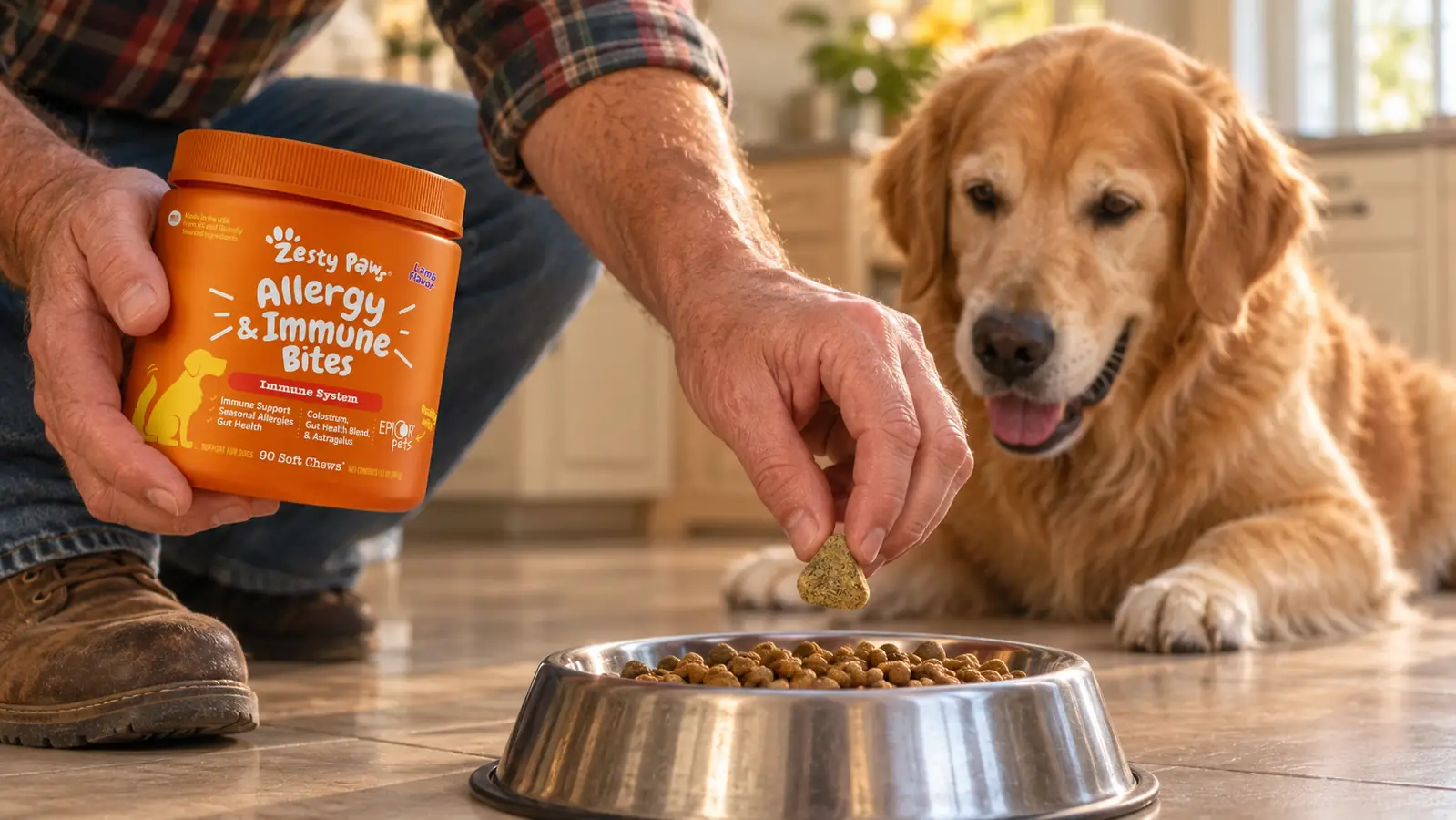
Ninety soft chews, lamb flavored, dosed by weight at one to three a day, with colostrum at 250 mg and EpiCor fermentate at 80 mg on the panel. Give it six to eight weeks before you decide anything.
Amazon Check Today's Price on Amazon →What Is Actually in the Tub
The tub holds 90 soft chews, lamb flavored, and the whole thing weighs 12.07 ounces. That number on the front, 90, gets read as months by a lot of people. It is not. The label doses by weight at one to three chews a day, so a big dog at the top of the range gets a 30 day supply. Do that arithmetic before you buy, because the arithmetic is the part of the label nobody photographs.
The two actives Zesty Paws names and quantifies are colostrum at 250 mg and EpiCor fermentate at 80 mg. EpiCor is a yeast fermentate, and that is the ingredient that made me stop and read the rest of the panel. It is not an antihistamine. It does not shut an itch down the way a steroid does. The idea is immune support, working on the body's own response over weeks instead of masking the symptom in an hour. Colostrum is the first milk, and it has been used in dogs with gut and skin complaints for a long time. The active list also shows an apple cider entry, and the product is filed under immune support along with digestive and gut health.
The form matters more than people give it credit for. A soft chew is the easiest delivery system there is for a dog who will not take a pill, and the lamb flavor is strong enough to cover whatever the colostrum tastes like. The tub itself measures 3.5 by 3.5 by 4 inches, small enough to sit on a pantry shelf without taking over. Soft chews will go hard if you leave the lid loose, so mine goes into a sealed plastic container and stays there between meals.
What is not in the tub matters just as much. There is no drug in here. Nothing in this chew will clear a bacterial skin infection, settle a hot spot, or do the work of the cytology swab our vet runs when Biscuit's ears get hot and red. If your dog's skin is greasy, smelly, or weeping, that is a clinic visit. This is a support product for a dog whose itch is seasonal and whose skin is otherwise intact, and it should be judged on that job only.
How I've Used It With Biscuit
Biscuit is 78 pounds. The label doses by weight between one and three chews, and a dog his size does not sit at the bottom of that range. I started him at two a day, one with breakfast and one with dinner, because a lamb chew on an empty stomach seemed like a poor idea for a dog who once threw up an entire sock. He ate both without ceremony. He is a Labrador and would eat a paper towel, so take that for what it is worth, but the chew is soft and he did not have to work at it.
The first two weeks, nothing happened. I want to be plain about that, because reviews promising a different dog in three days set people up to quit at day ten. We were somewhere around week four before I noticed the evening licking had gotten shorter. Not gone. Shorter. He still starts on the left front paw after dinner, but he stops after a minute instead of fifteen. By week six the skin between his toes had gone from pink back to a normal pale color, and the flaking on his belly was mostly gone.
I kept everything else the same for the whole six months, and that is the only reason I can say anything useful about the chew. Same food, same monthly flea prevention, same every-other-week shampoo through the winter. If I had changed three things at once I would have learned nothing except that something worked. The chew was the one addition. That is the whole basis for my opinion, and it is a sturdier basis than most of what gets written about supplements.
One practical note. We drive to see Ray's sister twice a year and the chews travel in a zip bag inside the cooler, because a soft chew left in a warm car turns into a lump. Biscuit does not skip doses when we travel, which matters for anything you are judging over months. If you are the sort of person who forgets by week three, set the tub next to the food scoop and it becomes part of the routine instead of a project.
What I Tried Before This
For three winters I squirted salmon oil over Biscuit's kibble. It helped his coat, and I still use it, but it did not touch the paw licking. Fish oil is a fine thing to have in a bowl and a poor thing to lean on for a seasonal itch. I kept it in the routine the whole time I tested the chews, which means the result I am describing sits on top of the oil, not instead of it.
The oatmeal baths helped for about a day. That is not nothing when your dog is miserable, but a bath treats the surface and the itch comes back from somewhere underneath. I still do them every other week in the winter, because otherwise the flaking ends up in the couch cushions. I no longer expect them to solve anything and they do not.
Before this I tried two of the bargain tubs from the big box store, the ones with brewers yeast and a cartoon dog on the front. Biscuit ate them, nothing changed, and I never bought a third. What is different here is not prettier marketing. It is that the panel names the ingredients and puts milligrams next to them, which lets you compare one tub against another and lets your vet tell you whether the amount is worth taking seriously.
The Timeline Nobody Mentions
Allergy chews do not work on the clock owners expect. If your dog is in the middle of a hot spot, a cone and a vet appointment will do more in two days than any chew will do in a month. A supplement like this works slowly, on an immune response that turns over in weeks. The honest test window is four to eight weeks. Anyone telling you to judge it at day five is selling, not testing.
There is a seasonal trap in that, too. If your dog itches from spring pollen and you start the chew in May, you are already behind the peak. You spend the first month chasing a problem at its worst and then decide the product failed. I started Biscuit's tub in October, ahead of the dry indoor season, and that timing is a large part of why I think it worked. Next year I will start in early September and get further ahead of it.
And itch has more than one cause. Food, fleas, pollen, mold, dry air, a new rug, a thyroid problem, a skin infection. A chew that supports the immune system can help with one of those and do nothing at all for the other seven. That is not a knock on the product. It is a knock on the way these things get sold, as though one tub covers every itchy dog on the street.
Biscuit's licking went from fifteen minutes a night to about two. Not zero. Two. That is what a support chew looks like when it is working.
Where It Fell Short
The lamb smell is real. It is not offensive exactly, but it is strong enough that I keep the tub inside a sealed container on the pantry shelf, and Ray has mentioned it more than once. If you have a picky dog, smell can work against you before the first chew is even offered. Biscuit would eat a flip flop, so I got lucky on that front. Juniper, our gray tabby, showed no interest, which is just as well, since these are dog chews and a cat has no business with them.
The dosing math is the other soft spot. Ninety chews at three a day is a month, not a season. In a house with two large dogs you would be reordering all winter long. I also did not love the size of the chew for a small dog. The listing says all breed sizes and the chew is soft enough to break in half, but a 12 pound terrier would be getting a fraction of a chew a day, and that gets fussy fast.
Most of all, it did not fix the allergy, because nothing in a tub can. Biscuit still licks in November. He still gets flaky when the heat runs. The chew made the season easier to get through and I will take that, but anyone promising a cured dog is selling you a story. Six months in, I replace the tub because the difference was real and because the difference was small.
What I'd Ask My Vet Before Starting
Twenty-four years at that front desk taught me the question owners ask most: is this safe with everything else he takes? Ask it. Bring the tub or a photo of the back panel and let your vet read the ingredient list next to the rest of your dog's medications. Colostrum and a yeast fermentate are generally well tolerated, but generally is not always, and a dog with a known yeast sensitivity is a different conversation from a dog without one.
The second question is whether the itch is actually allergic. Our vet has scraped and swabbed Biscuit's skin more than once, and one of those visits turned up a bacterial infection that no chew would have touched. A supplement can run alongside treatment. It cannot stand in for a diagnosis. If your dog is chewing himself raw, losing hair in patches, or giving off a smell from the skin, book the appointment first and think about chews afterward.
What I Liked
- Dosed by weight at one to three chews, so a large dog gets a real amount
- Panel names and quantifies colostrum at 250 mg and EpiCor fermentate at 80 mg
- Soft chew most dogs take without a fight
- Clear change in Biscuit's paw licking between week four and week six
- Can be given year round, not only at the peak of a flare
Where It Falls Short
- Ninety chews at the high dose is about a month, not a season
- Strong lamb smell that lingers in the pantry
- Eight weeks is a long time to wait for a maybe
- Does nothing for fleas, food allergies, or an active skin infection
- Large chew for very small dogs unless you break it
Who This Is For
This suits the owner of a dog with a seasonal, environmental itch. The dog who starts licking when the furnace comes on or when the pollen count climbs, and whose skin is otherwise intact between flares. It suits someone willing to give it six to eight weeks and keep the rest of the routine steady so the result actually means something. And it suits a household with a vet they trust, one who will say sure, try it alongside what we are already doing, and let you report back.
It also suits a house with a dog and a cat, as long as the chews stay with the dog. Juniper has her own shelf and her own things, and I have never offered her a lamb chew. Dog chews are dosed for dogs, and a cat is not a small dog. If you have both, store them apart and do not let a dropped chew become a cat snack.
Who Should Skip It
Skip it if your dog is miserable right now, because you need a clinic this week and not a supplement next month. Skip it if you suspect food, because the answer there is a proper elimination diet and not a chew. Skip it if your dog has a known yeast problem and you have not asked your vet about a yeast fermentate. And skip it if a 30 day supply at the label dose is going to stretch the household budget, since there are simpler ways to get omega threes into a bowl.
Six months in, the tub of Zesty Paws stays on the pantry shelf next to the joint chews, and I buy it in September rather than waiting for the first cold morning. That is about as strong an endorsement as I give anything. Not a cure, not fast, not for every dog. Useful for mine, in this season, at this dose, and worth telling you the whole of it.
Start in September, not in the middle of the flare
Biscuit's best winter in years started with a tub in October. If your dog's itch follows the season, get ahead of it this time instead of chasing it in January.
Amazon See Today's Price on Amazon →