
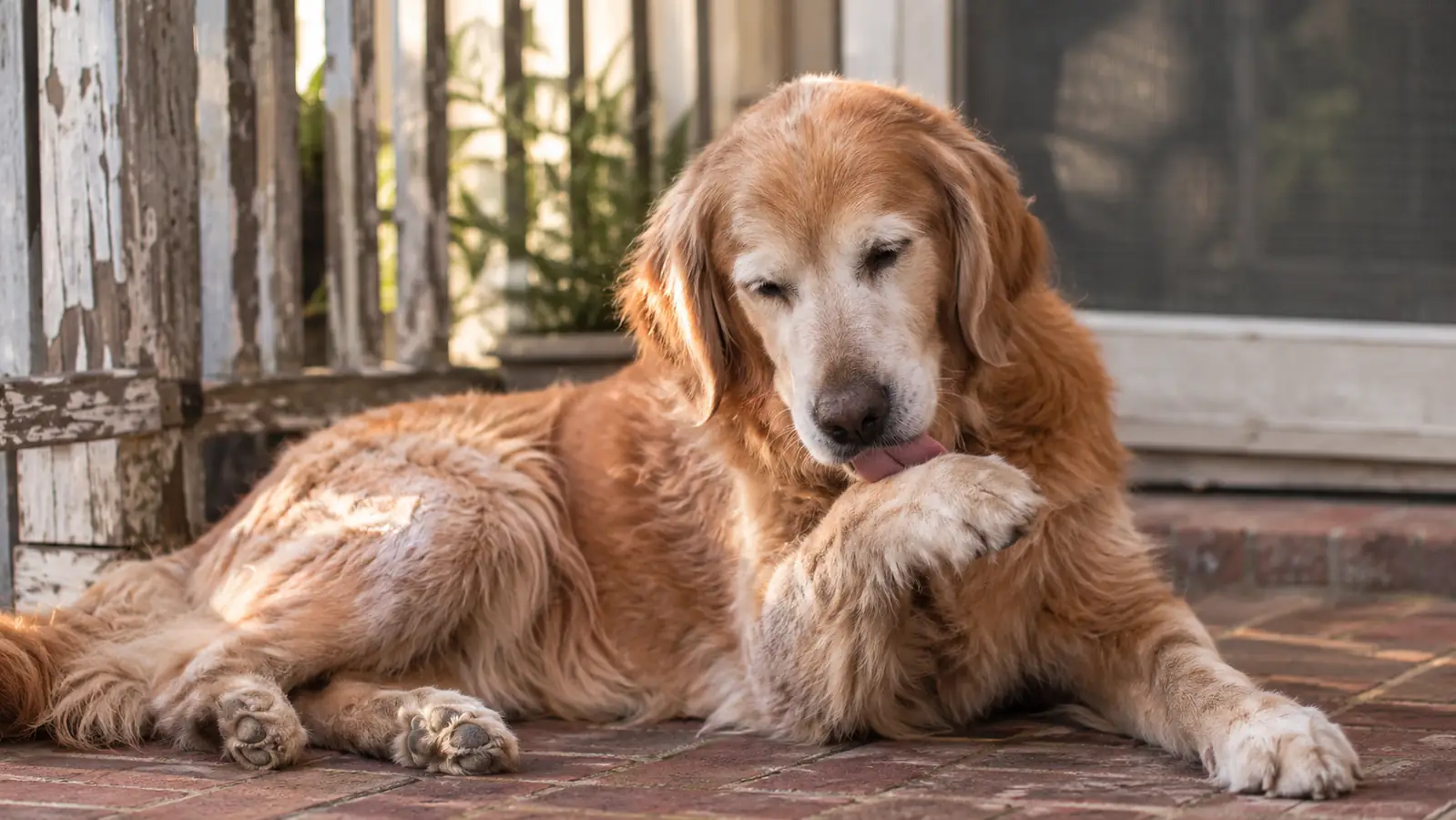
Biscuit turned ten in March, and by Thanksgiving his coat had gone to pieces. Flaky along the spine. Pink between the toes. And a wet chewing sound at two in the morning that would pull me out of a dead sleep. Ray started calling it the corn chip noise, and he was not wrong about the smell.
I spent twenty-four years behind the front desk of a small-animal clinic, so I have heard that sound described a thousand different ways. What do I do about my dog's itching. Where do I even start. So here is where we started: at our vet's office, because that is what I tell everybody else to do and I am not going to be the exception. Then in the pantry, with a tub of Zesty Paws Allergy Chews in lamb flavor, ninety soft chews to the tub, given every single day from the middle of November through the end of February. This is what happened, and what did not.
The Quick Verdict
Not a fix, and not a replacement for your vet. A lamb-flavored soft chew with colostrum and EpiCor printed on the label that stopped Biscuit's overnight chewing by week five. I bought the second tub.
Amazon Check Today's Price →If your dog is chewing at his paws tonight, start here
Ninety lamb soft chews per tub, dosed one to three a day by your dog's weight. Read the label, call your vet, then set the tub where you will see it every morning.
Amazon Check Today's Price on Amazon →How I've Used It
Biscuit is a ten-year-old yellow Lab, seventy-eight pounds, stiff in the hips on cold mornings and itchy in the winter, which is why there is a shelf in our pantry that looks like a small pharmacy. The tub of chews sits next to the coffee, and every morning he gets his before I get my second cup. That is not discipline on my part. It is placement. A supplement you forget half the week is a supplement you cannot judge, and I have wasted money on enough of those to know the difference.
The label doses by weight, one to three chews a day. At seventy-eight pounds Biscuit falls in the top bracket, so he got three a day, and that is a number worth doing out loud before you buy anything: ninety chews divided by three is thirty days, one tub to the month. I wrote the date on the lid with a marker. That sounds fussy and it turned out to be the only reason I can tell you honestly what changed and when, instead of squinting backward at a whole season and guessing.
The chew is soft, not a hard biscuit, and it gives a little between your fingers. Biscuit takes his in one bite without chewing, which is fine by me. Juniper, our eight-year-old tabby, stuck her nose in the tub exactly once and was escorted out of the kitchen. These are dog chews. A cat that eats a handful of them is a cat you will be calling your vet about, so keep the tub where she genuinely cannot reach it.
What's Actually on the Label
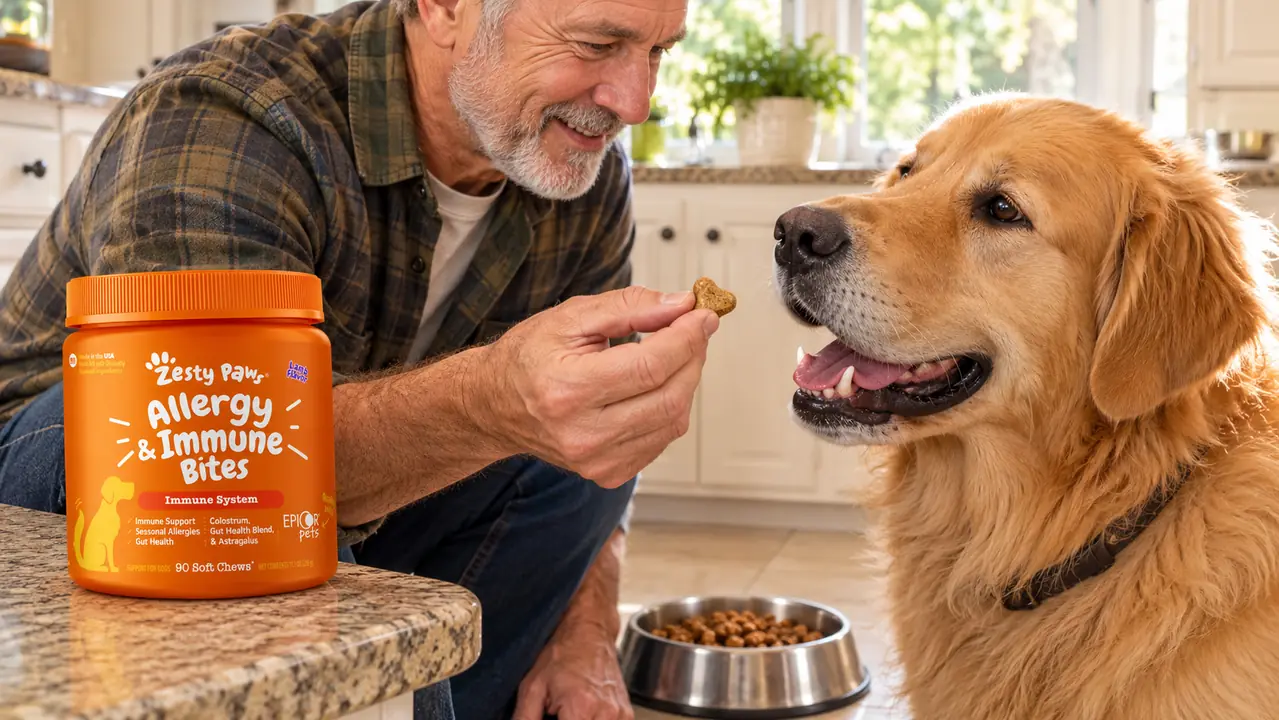
Two things on that label are the reason I chose these over a plain fish oil caplet. The first is colostrum, listed at 250 mg. The second is EpiCor, a yeast fermentate, listed at 80 mg, and the listing pairs the two for immune system support. Neither one is an antihistamine. Neither one is a steroid. They are not working on the itch the way a prescription does. The idea is that they support the immune system and the gut while your own routine handles the rest, and I want that on the table before I tell you what happened at my house.
The stated benefit is support for seasonal allergies, and the listed uses are digestive and gut health and immune support. That is a wider and vaguer claim than 'stops itching,' and you should read it as written. Nothing on the tub promises a cure. What Zesty Paws does give you is amounts, which is more than plenty of competitors do, and a soft chew in lamb flavor that most dogs will take off a flat palm. The tub measures 3.5 by 3.5 by 4 inches and weighs 12 ounces, so it is a small thing that fits on a shelf without rearranging anything.
What no label can tell you is whether your dog's itch is allergy at all. In a dog Biscuit's age it can be fleas, food, thyroid, a skin infection, or dry January air, and a chew will not sort that out for you. Our vet looked, scraped, and ruled things out before we started, which is the only reason I felt comfortable giving this a fair three months. If your dog has not been examined, put the tub down and make the appointment first.
What Three Months Actually Looked Like
The first two weeks, nothing. I want to be plain about that, because reviews that promise overnight relief are either describing a different product or a very lucky dog. On day four Biscuit chewed at his flank exactly the way he had on day one, and the flaking along his spine had not eased at all. I kept going because the tub was already open and because the honest answer to 'when will I know' is always a month.
Somewhere in week three the brushing got easier. The flakes came up on the brush in smaller amounts instead of snowing onto the kitchen floor, and his coat stopped feeling like straw along the back. Then in week five I noticed something I had not been looking for: I had slept through the night four nights running. The chewing had stopped. Not the paw licking, and not the head shaking, but the two a.m. noise that had been waking both of us since November. I noticed because the quiet woke me up.
What did not change matters just as much. In January the skin between his toes was still pink, and he still shook his head after every walk. Dry indoor heat is hard on an older dog with a thin coat, and no chew on earth was going to touch that. I added a wipe down with a damp cloth after walks and a medicated bath every other week, and honestly, those two chores did more for his paws than the chews did.
Which brings the question I would ask if I were sitting on the other side of the desk. Do I know it was the chews? No. I changed more than one thing in the same winter. What I can tell you is that I stopped them for two weeks in March to see what would happen, the night chewing came back by the fifth night, and I started them again. One dog, one season, no control group. It is also the most honest test I know how to run in my own kitchen.
The overnight chewing stopped in week five. The pink between his toes was still there in January. Both of those things are true, and I would rather tell you both than sell you a happy ending.
What I Don't Love
It is three chews a day, every day, and a tub is a month. Miss a week and you have spent a quarter of your supply learning nothing. If your household is the kind that remembers supplements the way other people remember to water the plants, this will be a short relationship, and I would rather say so now than have you find out in February.
Seventy-one thousand ratings averaging 4.2 stars is a good number and it is not a perfect one. That average means a real share of owners did not get what they hoped for, and the complaint I see most in that group is a loose stool in the first week. Biscuit had no trouble at all. If your dog has a sensitive gut, that is a conversation for your vet before the first chew, and starting with one a day instead of three is not going to hurt anything.
The lamb smell is real and it stays on your fingers. A dog who turns his nose up at lamb will turn it up at these, and I have no clever workaround beyond burying one in something he already likes, which rather defeats the point of a chew you can hand over plain.
And the last thing I do not love is how easily a supplement slides into the space where care should be. These are not flea control. They are not a food trial. They are not a substitute for a vet visit. The tub will not tell you that, so I am telling you.

What We Compared It To
Our vet offered a prescription route if the season turned bad, and we kept that option in our back pocket all winter without using it. For a ten-year-old Lab with mild symptoms and clean bloodwork, that was the right call. It would not be the right call for a dog chewing himself raw, and I want to be clear that a bad enough itch deserves the stronger tool, not the chew. Nobody should read this and delay an appointment.
Before any of this we tried the cheap route: a salmon oil squirted over his dinner and a store brand chew he ate for four days and then refused. The oil did help the flaking some, and I still keep it in the rotation. The chew went in the bin. That is the unglamorous history behind this review, and it is why I judge any chew on whether a dog will still take it in week three.
The other chew owners ask me about is Bark & Spark, and I will not pretend I ran both in this house. What I can say is that the two are built on different active panels, that both are immune and gut support rather than itch medicine, and that the right one is the one your dog will eat and your budget will carry for three months without complaint. A supplement you stop buying in week two is not a fair test of anything.
What I Liked
- Dosed by weight, one to three chews a day, so a 78-pound dog is easy to keep straight
- Colostrum at 250 mg and EpiCor fermentate at 80 mg both printed on the label with amounts
- Biscuit's overnight chewing stopped by week five and stayed stopped while he was on it
- Soft chew he takes in one bite, no crushing, no hiding in peanut butter
- Ninety chews is exactly one month at three a day, which makes honest record keeping simple
Where It Falls Short
- Three chews a day is a real daily commitment and a missed week is hard to make up
- The lamb smell is strong and stays on your fingers
- A share of those 71,000 ratings report loose stools in the first week
- It is immune and gut support, not an antihistamine, so a bad itch still needs your vet
- Picky dogs can refuse it, and there is no trick that fixes that
Who This Is For
This is for the owner of a dog whose itching has already been looked at, whose vet has used the word support rather than prescription, and who wants something to give daily while the rest of the routine does its work. It suits older dogs with winter coat trouble, dogs on a good flea preventive, and households willing to keep a calendar and a marker beside the tub.
It is also, frankly, for the person who wants amounts printed on a label. Zesty Paws lists colostrum at 250 mg and EpiCor at 80 mg, numbers I can read and repeat to our vet without translating anything. Plenty of chews on the market give you a proprietary blend and leave you guessing, and after twenty-four years of hearing owners read me labels over the phone, I have strong feelings about that.
Who Should Skip It
Skip it if your dog is tearing at himself, has open skin, or has never been examined for the itch. That dog needs a diagnosis and a chew is not one. Skip it if you have a cat who shares the room, unless you can keep the tub somewhere she genuinely cannot reach, because this is formulated for dogs and Juniper taught me that lesson in one afternoon.
Skip it if you will not give it daily for a month before judging it. Skip it if lamb is a no in your house. And skip it if your dog's stomach has reacted badly to new chews before, at least until your vet says otherwise. There is no shame in any of that. It is the same advice I gave across a counter for twenty-four years, and it did not get less true once I started taking it myself.
One tub, one month, one honest test on your own dog
If your dog's itch has already been looked at and the answer was support rather than prescription, this is the chew from Zesty Paws that got us through a Kentucky winter. Start with the label and your vet's blessing.
Amazon Check Today's Price on Amazon →