

I started keeping Cosequin on the pantry shelf for the same reason a lot of owners do. Biscuit, our 10-year-old yellow Labrador, had begun to pause at the bottom of the stairs. Not a yelp. Not a limp. Just a half-second hitch before he pushed himself up, the kind of thing you notice only because you have watched that dog move for a decade. He weighs 78 pounds, and on cold Lexington mornings his hips were stiff enough that I started warming his bed in the dryer before I let him out. Our vet checked him, ruled out the urgent stuff, and said a joint supplement was reasonable to try. That is how a 132 count bottle of Cosequin from Nutramax Laboratories ended up next to the kibble.
I had already tried a powder that smelled like fish and a soft chew Biscuit turned down after one sniff. I am not against either form. I am against paying for something that ends up in the trash. What I wanted was simple: a chewable tablet he would take without a fight, a label I could read, and a routine I could keep on a retired receptionist's schedule. Cosequin met the first two. The third took some adjusting.
The Quick Verdict
After four months, Cosequin is still in the pantry. It did not turn Biscuit into a puppy, but it made his cold-morning stiffness easier to manage.
Amazon Check Today's Price →A Joint Tablet Biscuit Takes Without a Fight
Cosequin is the chewable I keep on the shelf, and the 132 count bottle lasts through a slow, steady routine. Check the current price and count on Amazon.
Amazon Check Current Price on Amazon →How I've Used It
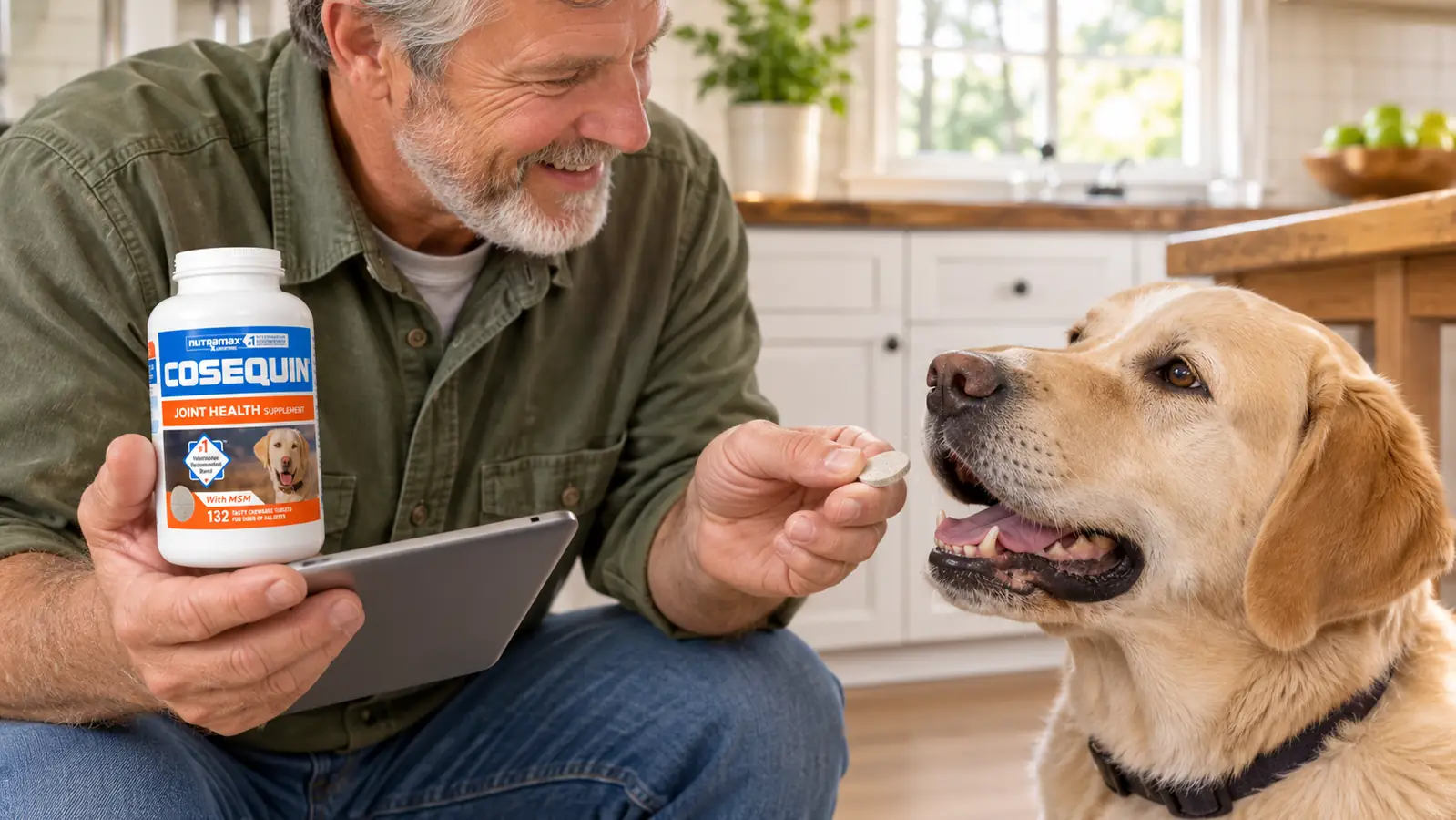
I started Biscuit on Cosequin in late October, a few weeks before the first hard frost. The label on the 132 count bottle is plain enough, and I followed the directions with our vet's blessing. I gave the tablet after breakfast, because Biscuit is more willing to try anything when he has already had a mouthful of food. He chews it. That sounds like a small thing until you have hidden a pill in peanut butter for a week and watched a dog spit it onto the rug.
The bottle is eight ounces, which matters less than you would think. What matters is that it is one container, not a tub of powder and a scoop that disappears. I keep it on the same shelf as Juniper's food, though Juniper does not take it. Our cat has her own sensitive stomach to manage, and I do not share supplements between species without asking our vet. I mention that because it is the kind of question I used to hear at the front desk every week.
For the first month I watched him like a hawk, which is not scientific. I was looking for a sign that it was worth the shelf space. I did not see a dramatic change. What I saw was smaller. He stopped hesitating quite so long before he stood up from the kitchen floor. He still took the stairs one at a time. He still slept harder on damp days. But the pause got shorter, and I stopped holding my breath every time he got up.
I also kept the rest of his routine steady, which is the only way I know to judge a supplement fairly. Same food. Same walks, though I shortened the afternoon loop when the sidewalks got icy. Same bed. If I had changed three things at once and seen a difference, I would not have known what to credit. A retired receptionist learns a little about controlled variables from listening to owners argue with themselves in the waiting room.
One thing I did not do was double up. When a supplement is slow, the temptation is to give more of it, and that is a bad habit with any product that carries a label. I gave what the bottle said to give and let the weeks do the work. If you are the sort of person who keeps a notebook, keep one. If you are not, put a mark on the calendar every Sunday and trust that more than your memory. My memory would have told me the change came faster than it did.
What I Watched For
I watched four things: how long Biscuit paused before standing, how he handled the three steps at the back door, whether he lagged on the morning walk, and how he settled after exercise. I did not watch for a dramatic turnaround. I watched for a trend. I wrote a note on the calendar every Sunday, mostly because I have a poor memory and because I wanted something better than a feeling to report to our vet.
That calendar is the reason I can say the change was gradual. The first two weeks looked like nothing. Weeks three and four looked like nothing. Around week five I noticed I was not waiting for him at the back door anymore. By week eight the morning pause was short enough that I had to remind myself it used to be longer. I read the Nutramax Laboratories label again at that point, mostly to check that I had not talked myself into a result.
What Is in Cosequin and Why It Matters
Cosequin is a chewable tablet for dogs, not a prescription pain medication. The active ingredients listed on the product are glucosamine hydrochloride, methylsulfonylmethane, which is usually shortened to MSM, and sodium chondroitin sulfate. The listing also names the glucosamine as FCHG49 and the chondroitin as TRH122. Those are the company's names for its ingredients, and they are worth knowing if you compare labels. Nutramax Laboratories has been in pet health for more than 25 years, and the label says Cosequin is the number one vet recommended retail joint health supplement brand.
I am not going to pretend I can explain the biochemistry better than a veterinarian. What I can tell you is what those ingredients are commonly used for. Glucosamine and chondroitin are the pair most owners have heard of when the conversation turns to joint support. MSM is often included alongside them. Cosequin puts all three in a tablet, which is the reason I was willing to try it instead of ordering three separate powders and mixing them in a bowl.
The label is also clear about what it is not. It is not a cure for arthritis. It is not a substitute for weight control, good bedding, or a vet visit when a dog is suddenly lame. I have watched owners buy a supplement and then skip the harder parts, like cutting back treats or putting a ramp at the back door. A tablet cannot do that work. What a tablet can do is support the joint health routine you are already keeping. That is a smaller promise, and it is the honest one.
The product listing says it is for small, average, and large dogs, and Biscuit sits in the middle of that range at 78 pounds. The item form is a tablet, the bottle is eight ounces, and the count is 132. Those are the facts I can give you without dressing them up. The rest is my experience with one dog, and I would rather tell you that plainly than pretend a supplement works the same way for every animal.
The change was not dramatic. It was a shorter pause before Biscuit stood up, and after four months I would take that.
What Changed Over Four Months
By week six, I could see the difference in the morning. Biscuit sleeps on an orthopedic bed in the corner of our room. He used to lie there for a minute after he woke, as if he were deciding whether getting up was worth it. In November he started rising on his own and walking to the kitchen before I had my slippers on. That is not a cure. It is a better morning. I will take a better morning.
The walks told a quieter version of the same story. Biscuit has never been a puller, but he used to fall behind on the last block and I would shorten my stride to keep him beside me. Somewhere in November I stopped shortening my stride. He was still at the end of the leash when we turned into the driveway. If you have an older dog, you know how much of a walk is spent negotiating pace. That negotiation got easier.
The bigger test came in December, when Ray and I drove to see family and Biscuit spent more time on a hard floor than he does at home. I packed the Cosequin in a zip bag and kept the schedule. He was stiff after the car ride, which is normal for a 10-year-old Lab. But he recovered faster than he had the previous holiday. I cannot prove the tablet did that. I can tell you the routine did not fall apart, and that counted for something.
His coat is a separate story. Biscuit gets flaky and itchy in winter, and Cosequin is not a skin and coat supplement. I did not expect it to fix that, and it did not. I kept him on his fish oil and brushed him more often. If you are looking at Cosequin for itching, you are looking at the wrong shelf. If you are looking at it because your older dog is slow to rise, that is the conversation this product belongs in.
The last change was in me. I stopped watching him like a problem to solve and went back to watching him like a dog. That sounds sentimental, and maybe it is. But there is a point with an aging pet when you stop expecting the clock to turn back and start looking for the small comforts that make the day easier. Cosequin is one of those comforts in this house. It is not the whole answer, and I would not want anyone to think it is.

The Parts That Were Not Perfect
The first con is time. Nothing happened in the first week. Nothing much happened in the second. I have heard the same thing from other owners, and the label does not promise overnight results. If you need a dog to be more comfortable today, call your vet. A joint supplement is a slow habit, not an emergency plan.
The second con is the tablet itself. Biscuit takes it, but he is a Labrador, and Labradors are not famous for refusing food. A pickier dog may need the tablet broken into a smaller piece or tucked into a little wet food. The product is chewable, not a treat. Do not expect a dog to treat it like a snack.
The third con is that I cannot tell you how much of the improvement came from Cosequin and how much came from the other changes we made. We put a runner at the bottom of the stairs. I stopped letting Biscuit jump off the sofa. He lost a little weight because I cut back on table scraps. Any honest review of a joint supplement has to admit that the supplement is one part of a larger routine. I would not trust a review that claimed otherwise.
The fourth con is cost over time. I am not going to quote a price because prices move and because I do not want to turn this into a sales page. I will say that a daily supplement is a recurring cost, and a 132 count bottle only lasts so long. If the budget is tight, ask your vet whether a different product or a different routine makes more sense. A supplement you cannot afford to keep using is not much help.
What I Liked
- Biscuit takes the chewable tablet without hiding it in food.
- The ingredient list is short and readable: glucosamine, chondroitin, and MSM.
- The 132 count bottle fits a daily routine without a scoop or a powder tub.
- Our vet approved it as a reasonable joint supplement to try.
- It is from Nutramax Laboratories, a company with more than 25 years in pet health.
Where It Falls Short
- It took close to six weeks before I noticed a change.
- It does not address Biscuit's itchy winter coat.
- A picky dog may still need the tablet broken up or mixed with wet food.
- It is not a pain medication and will not replace a vet visit for a lame dog.
Who This Is For
Cosequin is for the owner of an aging dog who wants to start a joint support habit and is willing to give it time. It fits dogs that will take a chewable tablet, and it fits owners who want a simple label with the familiar glucosamine and chondroitin pair. Biscuit is a medium-to-large dog at 78 pounds, and the product listing says it is for small, average, and large dogs. If your dog is stiff in the hips, slow to rise, or less eager on the morning walk, this is the kind of product to ask your vet about.
I would also say this. If you are already keeping a careful routine, if you have a vet who knows your dog, and if you can give a supplement a fair trial without expecting a dramatic result, Cosequin is a reasonable choice. It is not the only one. It is the one that stayed on our shelf.
Who Should Skip It
Skip it if you need a pain plan, not a supplement. A dog that is yelping, holding up a leg, or refusing to eat needs a vet, not a chewable tablet from the pantry. Skip it if your dog has a sensitive stomach and you have not asked your vet about new ingredients. Skip it if you are looking for a skin and coat fix, because that is a different product. And skip it if you share a house with a cat and are thinking of splitting the bottle. This is a dog product, and Juniper gets her own shelf.
Skip it if you cannot keep a daily routine. A supplement that is given three days a week and then forgotten for a month will not tell you anything. And skip it if you expect a guarantee. I have a 10-year-old Labrador. I do not expect him to move like a two-year-old again. I expect him to be comfortable enough to enjoy his walk, and Cosequin has helped with that.
If Your Older Dog Is Slow to Rise, Start With a Vet Conversation
Then look at the label, the count, and the routine you can keep. Cosequin is the chewable tablet that stayed on our shelf for four months.
Amazon Check Current Price on Amazon →