

Every October, Biscuit starts licking his front paws like they owe him money. He is a 10-year-old yellow Lab, 78 pounds, and by the time the furnace comes on he has licked a bare patch between his toes and I have bought three different shampoos. If you are reading this, you probably have your own version of that dog and your own shelf of half-used bottles. Zesty Paws Dog Allergy Chews are one of the things that stays on the pantry shelf in this house now, and this is the plain version of why.
Two things before we start. I am not a veterinarian. I spent 24 years at the front desk of a small-animal clinic in Lexington, which means I have heard this question a few thousand times and I know what our vet asks before she reaches for anything. And a chew is not a cure. Itch has a dozen causes, from fleas to food to thyroid to plain dry winter air, and no supplement sorts that out for you. What a chew can do is support the systems underneath the skin while you and your vet work out the rest.
The chew that lives on my pantry shelf
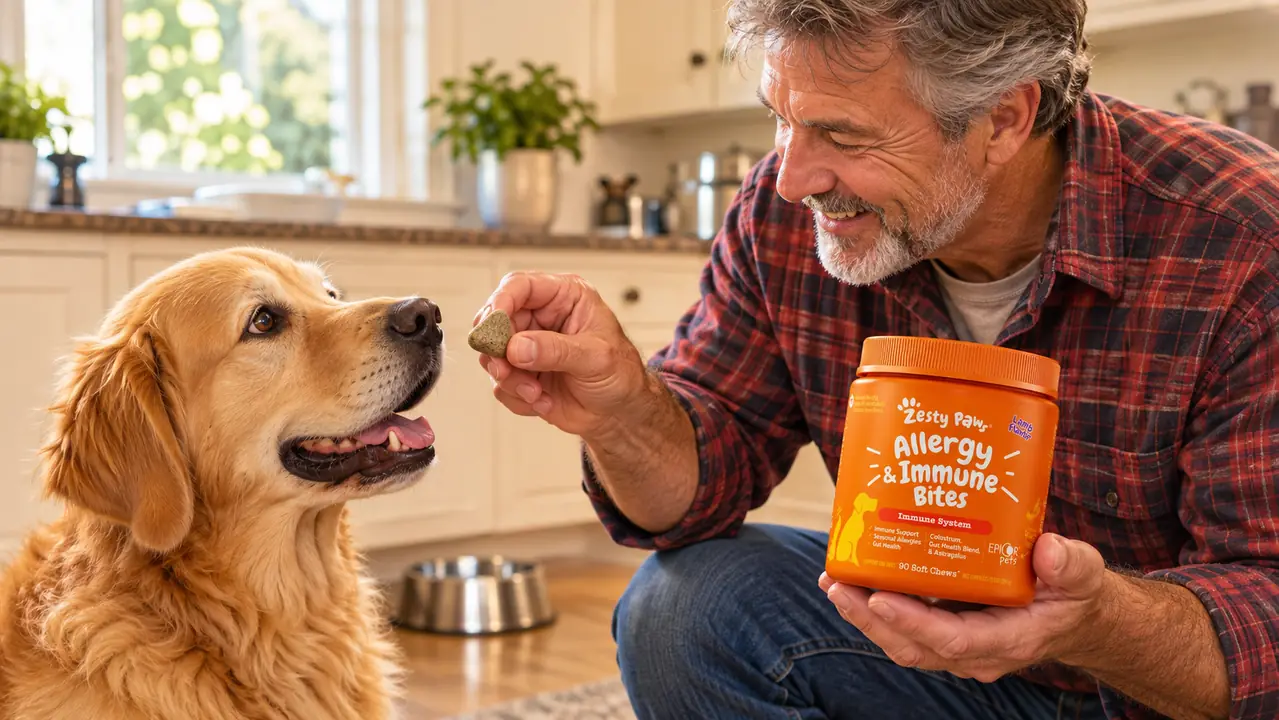
Zesty Paws Allergy Chews, lamb flavor, 90 soft chews. Colostrum at 250 mg, EpiCor fermentate at 80 mg, and a label you can read out loud to your vet.
Amazon Check Today's Price on Amazon →It works on the immune system, not just the itch
Scratching is the symptom. What sits underneath it is an immune system that has decided your dog's own skin is the problem. Zesty Paws built these chews around that idea: the stated job on the label is immune support, not numbing a spot for an hour. That distinction matters. A cream touches the surface until the dog licks it off. A chew goes through the dog, every day, and reaches the thing that keeps reacting. If your dog's itch runs for weeks every fall, you want something aimed at the system, not the patch.
The colostrum is dosed at 250 mg, in plain numbers
I have squinted at a lot of supplement labels over the years, and most of them hide behind a proprietary blend so you cannot tell whether there is a spoonful of the good stuff in there or a dusting. This one prints colostrum at 250 mg. Colostrum is the first milk, and it gets used for gut lining and immune support. I am not going to tell you it will fix your dog. I am telling you that you can read that number to your vet and get a real answer instead of a shrug.
EpiCor fermentate at 80 mg is a name your vet can look up
EpiCor Pets is a yeast fermentate, made using Saccharomyces cerevisiae, and it appears at 80 mg on this label. Here is why named ingredients matter to me. When I called the clinic about my own dog and said she is on EpiCor, the technician found it in ten seconds and told me what to watch for. When I said she is on a skin blend, nobody knew anything. You do not have to understand the science. You only have to be able to hand the bottle to someone who does.
Apple cider vinegar is on the active list
Apple cider vinegar has been the kitchen-cabinet answer to itchy paws for about as long as I have been alive, usually dabbed on with a cotton ball while the dog backs out of the room. Here it sits inside the chew instead, listed among the actives alongside the colostrum and the fermentate. I am not claiming it does the heavy lifting on its own, and I would not build a plan around vinegar alone. But its presence tells you what the formula is trying to do, and it tells you this is not just a flavored treat.
It is a soft chew, so there is no pill fight
Biscuit is a Labrador, so pills are not the problem in this house. He would eat a gravel driveway if I put it in his bowl. Plenty of dogs are not like that, and if yours spits out tablets and eats the cheese around them, a soft chew removes an entire evening ritual. It takes about three seconds at the bowl and you are done. That sounds like a small thing until you have run the peanut butter routine twice a day for a month and started to dread it.

Lamb flavor, which matters more than people admit
Some dogs turn their nose up at anything that smells like fish, and a supplement a dog will not eat is a supplement you have wasted money on. This one is lamb. If your dog has done fine on lamb treats before, that is a reasonable bet. If your dog has a known reaction to lamb, this is not the chew for you, and I would rather say that plainly than sell you a container. Watch the first one closely. You will know in ten seconds which way it is going.
The dose scales with your dog, 1 to 3 chews
The label gives 1 to 3 chews a day depending on weight, so a 78-pound Lab sits further up that range than a terrier would. That is a normal way to dose a chew, but it means the container lasts different lengths of time in different houses. Do the arithmetic before you order a second one. At the top of the range, 90 chews goes faster than you think. If your dog sits at the bottom of the range, you will be set for a good while.
You can give it year round, not just in ragweed season
The listing frames this as seasonal allergy support, and the honest reading is that it can be given year round as well. Winter itch is real. Ours arrives with the furnace and the dry air, and it lasts until the windows open again. Ragweed season is real too. If your dog itches for six weeks a year, you can time it. If your dog itches from October to April, you want something you are not stopping and starting every few weeks.
It fits alongside your vet's plan instead of replacing it
Here is the part I would say across the desk. Tell your vet what your dog is taking. Every time. Bring the container or a photo of the label. A chew like this sits beside whatever else is happening, whether that is prescription food, a flea plan or a medicated shampoo, and the vet needs the whole list to think clearly. Nobody at that clinic minds that you tried something on your own. They mind being handed a surprise halfway through a treatment.
It is a sensible first step while you work out the cause
Most people start a chew because they do not yet know why the dog is itchy and the vet appointment is two weeks out. That is a reasonable place to start, as long as you know what you are buying: something that supports the immune system and the gut while the actual answer gets found. If the itching is severe, if the skin is broken, if there is hair loss or a smell, skip the chew and go straight in. That is not a supplement question.
What I'd Skip
Things I would not buy. I would not buy a chew that lists a proprietary blend and no amounts, because you cannot check it and neither can your vet. I would not buy two different allergy chews and give both at once. You will not know which one helped, and you will have doubled an ingredient without asking anyone. I would not use a chew as a substitute for flea control. I would not keep going past eight or ten weeks if nothing has changed. And I would not expect a lamb chew to solve a food allergy, because if lamb is the problem, this is the worst possible choice. Ask first, then buy.
Four weeks in, the two-in-the-morning licking stopped. Not a cure. Just a quieter house and a dog who sleeps through.
One chew, one number to read to your vet
90 soft chews in lamb flavor, colostrum at 250 mg and EpiCor fermentate at 80 mg. Start there, give it a few weeks, and keep your vet in the loop.
Amazon Check Today's Price on Amazon →