

I know the sound. Biscuit gets up off the kitchen floor, there is a half second hitch in his back end, and then he walks it off like nothing happened. He is ten years old, seventy eight pounds, and the hips are where the years showed up first. Cold mornings are worse. So are the days after he has spent too long lying on the hardwood instead of the rug. You probably know that sound too, or you would not be reading this. And you have probably already stood in the supplement aisle with a bottle in each hand, reading the same four words on every label and getting no help at all from any of them.
What I want to give you is narrower than a recommendation. It is a sequence. Five steps, in order, so that when you finish you will actually know whether the thing you bought did anything for your dog, instead of guessing for a year and then quietly stopping and never quite knowing why. The product I will use as the example throughout is Cosequin, the chewable joint supplement from Nutramax Laboratories. It is the one I know best, partly because it is the one our clinic desk heard about most often and partly because it is what sits on the pantry shelf in our house now. The five steps work the same for any glucosamine supplement. Cosequin is just the version I can describe accurately, down to the count on the bottle.
The Bottle That Started This Whole Sequence
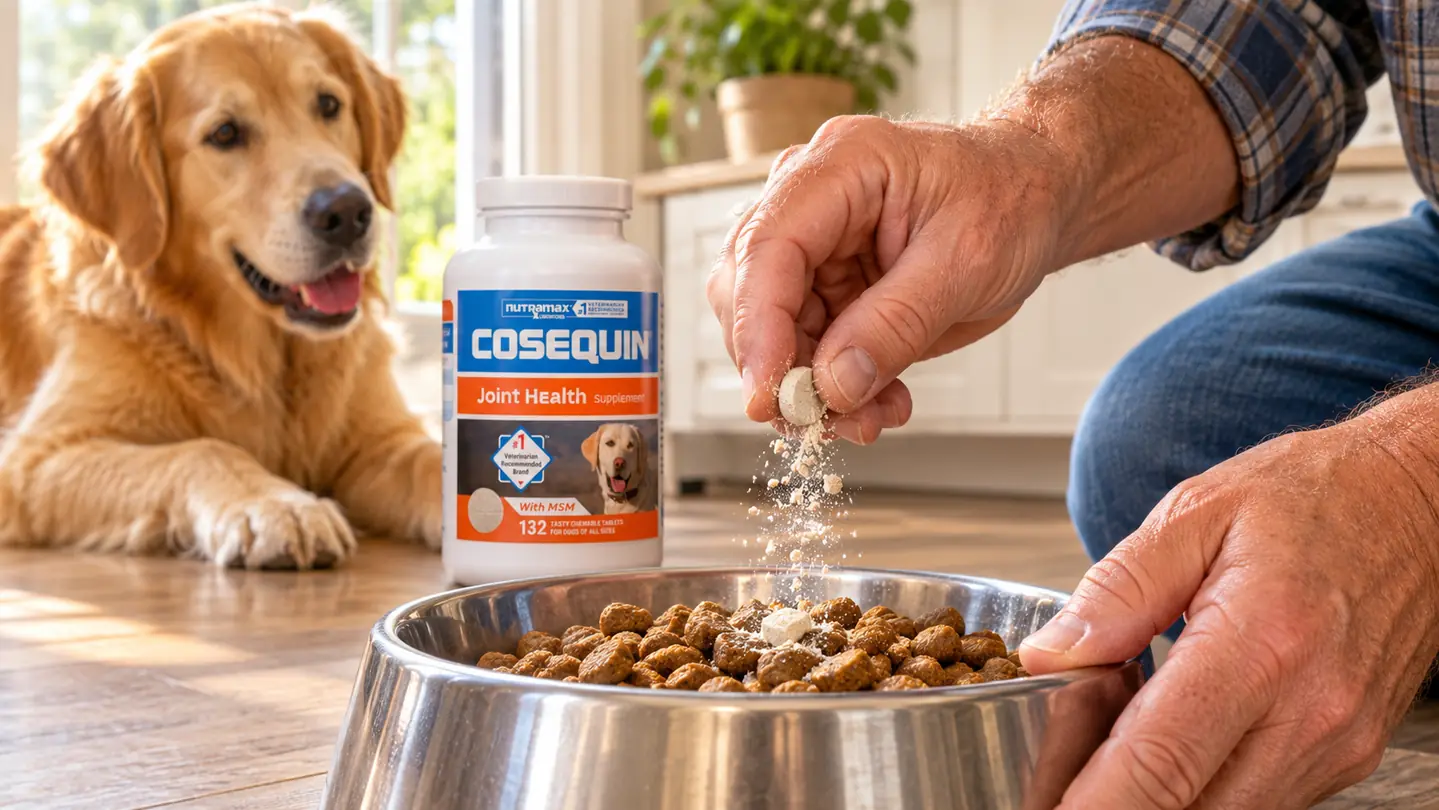
Cosequin chewable tablets for dogs, 132 count, from Nutramax Laboratories. Glucosamine hydrochloride, sodium chondroitin sulfate, and MSM, in a chewable you can hand over or crumble into dinner.
Amazon Check Today's Price on Amazon →Step 1: Rule Out the Things a Supplement Cannot Fix
Before anything goes into the bowl, get your vet to put hands on the dog. I spent twenty four years behind the front desk of a small animal clinic, and the number of owners who started a joint supplement for a limp that turned out to be a torn ligament, a nail curled into the pad, or a sore back is not a small one. Stiffness in the back end of an older Labrador has several possible sources, and only some of them answer to glucosamine. Buying first and asking later is how people end up eight weeks down a road that was never going to lead anywhere.
What you want out of that visit is a working diagnosis, not a permission slip. Ask directly: is this the joint, is this soft tissue, is this nerve, is this weight. Ask whether the hips and knees should be X rayed so you have something real to compare against in two years. Ask whether there is anything in the exam that makes a supplement a bad idea, and whether anything the dog already takes would interact with one. A glucosamine product is not a harmless nothing. It is something you are adding to a body that is already running its own chemistry, and it deserves the same question you would ask about any pill.
Then write the answer down. Ours went on the inside of a kitchen cabinet door with the date beside it, in pencil, because pencil can be corrected. That note is worth more than any review you will read, including mine, because it is about your dog and not about an average of ninety three thousand other dogs.
Step 2: Write Down What You See Before You Change Anything
Stiffness is easy to see and hard to remember. Three weeks in, you will not be able to say honestly whether the dog is better or whether you have simply gotten used to the way he moves. Memory is generous that way, and it will tell you the thing you were hoping to hear. So make a record before you change one part of his routine, not after.
Do it on a phone, on one flat stretch of ground, at the same time of day. Walk the dog away from you and back toward you, ten seconds each way, and hold the phone low so you are filming the legs rather than the top of his head. Do it once on a cold morning and once on a warm afternoon, because those are two different dogs and you need both on file. If your yard is uneven, use the sidewalk out front and use that same stretch every time so the comparison is fair.
Then write down four things. How long it takes him to rise from lying down. Whether he hesitates at the stairs or the car door. Whether he sits off to one side. And how far he wants to walk before he starts lagging behind you. Those four notes will tell you more in six weeks than any label claim ever will, and they cost you a pen. Keep them where you will actually look at them, not in an app you will forget you downloaded.
Step 3: Start at the Bottle's Own Count and Go Slow
Give the chewable time, and give it exactly the way the label says to. Cosequin chewable tablets for dogs come in a 132 count bottle, and the label sets the amount. Follow that count, and follow whatever your vet adjusts it to, rather than improvising a bigger number because you want it to work faster. More is not faster here. It is just more, and it is money out of your pocket and an upset stomach you did not need to cause.
The ingredient panel lists three actives: glucosamine hydrochloride, sodium chondroitin sulfate, and MSM. On the bottle you will see the codes FCHG49 beside the glucosamine and TRH122 beside the chondroitin. Those are the company's own identifiers for the specific ingredient forms it uses, and they are the reason people walk up to a counter and ask for this brand by name instead of pointing at whatever is on sale that week. Nutramax Laboratories has been making it long enough that most clinic staff can put a hand on it without looking.
Some dogs take a chewable straight from the hand and think it is a treat. Biscuit did that for about a week and then decided he was too good for it, so now it gets crumbled over his dinner and I check the bowl afterward to be sure it actually went in. If your dog is a gulper, watch the bowl closely for the first several days. A tablet left on the floor is a tablet that did nothing, and you will have spent two months testing an empty bowl and blaming the product.

Step 4: Fix the Free Things While the Chewables Work
While the chewables are working, fix the things that cost nothing, because on a stiff older dog they can do as much as anything that comes in a bottle. This is the part people skip, and then they wonder why the bottle did not carry the whole load by itself.
Weight comes first. Every extra pound on a dog with sore hips is a pound those hips carry on every single step, up the stairs and down again. Our vet's line, which I repeated to a hundred owners from that desk, is that the cheapest joint supplement is a smaller dinner. Ask the clinic to weigh him and give you a target number, rather than judging from the shape of him under all that winter fur. Most of us are wrong about our own dog's weight by several pounds in the direction we would prefer.
Then the floor. A non slip rug where he gets up. A bed thick enough that his elbows do not touch the ground. Nails trimmed so the foot lands flat instead of rocking forward. Several short walks beat one long one, and slow pavement beats a fast mile every time. Warmth helps too, which is why you will find the old ones lying in a patch of January sun like they have found religion, and why a ramp into the car is worth more than a fourth supplement.
Step 5: Give It a Real Window Before You Judge It
This is the step where people either quit too early or keep going too long on hope. Glucosamine is not a painkiller. It does not work in an afternoon, and if you decide on day four that nothing is happening, you have not tested it. You have just stopped and called it a result, and the dog is no better off for the money you already spent.
Our vet's rule of thumb was six to eight weeks before making a judgment, with the cold morning video taken again at the very end of it. Some owners see something sooner than that, and some see nothing at all, in eight weeks or in eight months. That is a real outcome and not a failure on your part. Not every stiff dog has the same cause behind the stiffness, and not every cause answers to the same bottle, which is the whole reason step one exists.
When the window closes, put the two videos side by side on the same screen and watch them before you decide anything. If the rise is faster and the lag comes later in the walk, keep going and set a new date. If the two clips are identical, you have a clean answer and you can stop spending without lying awake about it. Either way, tell your vet what you saw. That note goes in the record, and it helps the next decision, whether that turns out to be a different supplement, a pain plan, or nothing at all.
What Else Helps
A supplement is one lever among several, and the rest deserve to be named plainly. The scale is the biggest one. If your dog is carrying even a few pounds over his ideal, taking them off will change how he moves faster than any chewable on the shelf, and it costs nothing but the measuring cup and some discipline about table scraps and the grandkids.
If the joint has already been X rayed and graded, ask whether a prescription pain medication or a physical therapy plan belongs in the mix, and whether a supplement should sit alongside them rather than replace them. It is not either or. Ask, too, about the other end of the house. Cats hide joint pain far better than dogs do, and an eight year old tabby who has stopped jumping onto the windowsill is telling you something she will never say out loud. There is a feline version of this product from Nutramax Laboratories, but do not split a dog tablet with a cat. The counts are not the same and neither is the load.
One more practical thing, and it is the one nobody writes down. Keep the bottle where you will see it at the same hour every day, and mark the start date on the lid in marker. In our house the supplements live on a shelf in the kitchen pantry, and the date on the lid is the only reason I can tell you how long anything has actually been given rather than how long it feels like it has been given. Those two numbers are never the same.
Put the two videos side by side and watch them before you decide anything. If the rise is faster and the lag comes later in the walk, keep going.
The One Step of This You Can Actually Buy
Cosequin chewable tablets for dogs, 132 count, from Nutramax Laboratories. Glucosamine hydrochloride, sodium chondroitin sulfate, and MSM, in a form you can hand over as a treat or crumble into dinner. Check with your vet first, then write the date on the lid.
Amazon Check Today's Price on Amazon →